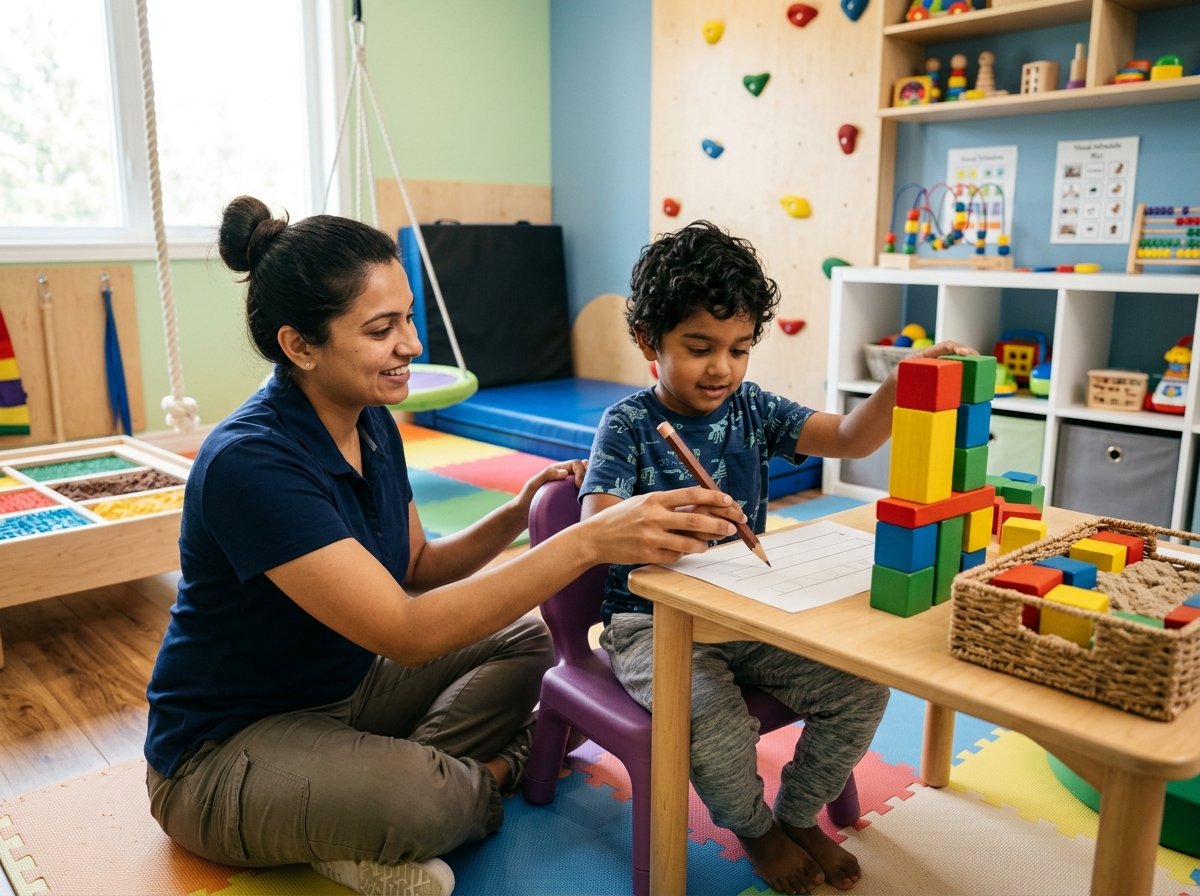
Conditions & Milestones Addressed
- Weak Pencil Grip & Handwriting Difficulty
- Fine Motor & Bilateral Coordination Delays
- Activities of Daily Living (Buttoning, Feeding, Dressing)
- Visual-Motor Integration Challenges
- Sensory Processing & Attention Regulation
- Motor Planning (Dyspraxia) Support
Our Clinical Assessment Process
Our occupational therapists evaluate hand-arch strength, grasp maturity, bilateral hand use, visual-motor integration, and sensory thresholds.
Therapy Approach & Methodology
Through graded play activities, pegboards, tactile manipulation, ergonomic writing adaptations, and structured ADL routines, children build confidence and functional autonomy.
How Families Support Progress
Encourage age-appropriate independence at home—such as scooping food, tearing paper, playing with clay, and zipping bags—rather than completing every fine motor task for your child.
Visit Our Paharia, Varanasi Centre
All assessments and therapy sessions are delivered in person at Sri Nagar Colony, Paharia, Varanasi—easily accessible from Sarnath, Pandeypur, Sigra, Lanka, Cantt, and nearby districts.
Book Your Child's EvaluationFrequently Asked Questions
What does a pediatric occupational therapist help with?
A pediatric occupational therapist helps children master everyday "occupations" such as holding a pencil, using utensils, dressing independently, staying calm in noisy environments, and participating in classroom tasks.
Is occupational therapy helpful for Autism and ADHD?
Yes. Occupational therapy and sensory integration frequently help children with Autism or ADHD regulate sensory input, improve seated focus, and build daily self-care routines.